
Complete Guide to Bourdon Tube Pressure Gauges: Working Principle, Types & Industrial Applications
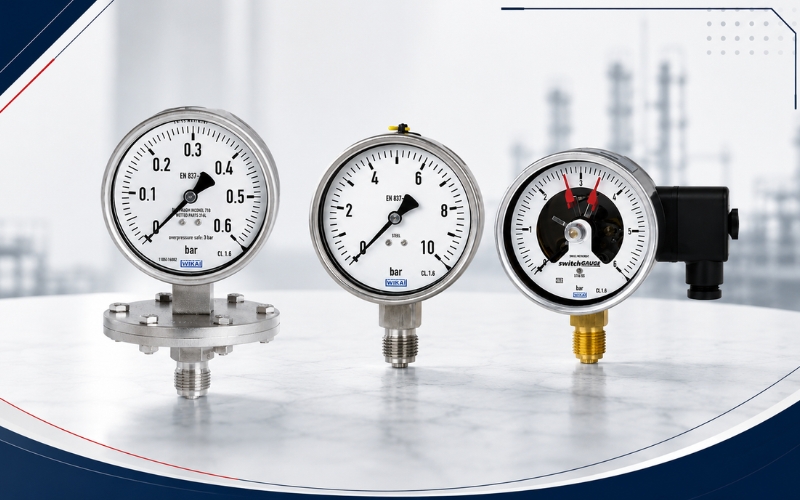
Pressure measurement is a critical aspect of industrial operations, ensuring the safe and efficient functioning of machinery, pipelines, hydraulic systems, and process equipment. From manufacturing plants and chemical industries to oil & gas, pharmaceuticals, water treatment, and power generation, pressure gauges play an essential role in monitoring system performance and preventing equipment failures. Among the various types of pressure measuring instruments, the Bourdon Tube Pressure Gauge is the most widely used due to its simple design, high accuracy, durability, and ability to measure a wide range of pressures.
Invented by French engineer Eugène Bourdon, the Bourdon tube mechanism has become the industry standard for pressure measurement. It is suitable for measuring the pressure of gases, liquids, steam, and other non-crystallising media across various industrial applications.
Jayantilal Bros. offers a comprehensive range of Bourdon Tube Pressure Gauges, Stainless Steel Pressure Gauges, WIKA Pressure Gauges, Baumer Pressure Gauges, Chemical Sealed Pressure Gauges, and Industrial Measuring Instruments designed to deliver reliable and accurate pressure monitoring. This guide explains the working principle, construction, types, applications, benefits, maintenance, and selection process for Bourdon Tube Pressure Gauges.
What is a Bourdon Tube Pressure Gauge?
A Bourdon Tube Pressure Gauge is a mechanical pressure measuring instrument that uses a curved metallic tube (known as a Bourdon tube) to measure the pressure of gases or liquids. As pressure enters the tube, it tends to straighten slightly. This movement is transferred through a mechanical linkage to a pointer, which displays the pressure on a calibrated dial.
Because of its robust construction and reliable performance, the Bourdon Tube Pressure Gauge is one of the most commonly used pressure measuring instruments in industrial applications.
It is suitable for measuring:
- Air Pressure
- Water Pressure
- Oil Pressure
- Steam Pressure
- Gas Pressure
- Hydraulic Pressure
- Pneumatic Pressure
How Does a Bourdon Tube Pressure Gauge Work?
The working principle of a Bourdon Pressure Gauge is based on the elastic deformation of a curved metal tube.
The process works as follows:
- Process pressure enters the Bourdon tube.
- The curved tube attempts to straighten as pressure increases.
- The movement is transferred through a linkage and gear mechanism.
- The pointer rotates over the dial.
- The dial displays the corresponding pressure value.
As pressure decreases, the Bourdon tube returns to its original position, providing continuous and accurate pressure indication.
Construction of a Bourdon Tube Pressure Gauge
A standard Bourdon Tube Pressure Gauge consists of the following components:
Bourdon Tube
The primary sensing element responsible for detecting pressure changes.
Socket
Connects the gauge to the pressure system.
Linkage Mechanism
Transfers the movement of the Bourdon tube to the gear assembly.
Sector Gear & Pinion
Converts linear motion into rotary movement.
Pointer
Indicates pressure on the calibrated dial.
Dial
Displays pressure in units such as:
- Bar
- PSI
- kPa
- MPa
Case
Protects the internal mechanism from dust, moisture, and environmental conditions.
Types of Bourdon Tube Pressure Gauges
1. C-Type Bourdon Tube Pressure Gauge
The C-Type Bourdon Tube is the most commonly used design for measuring low to medium pressure.
Applications:
- Air Compressors
- Pumps
- Water Systems
- Industrial Equipment
2. Spiral Bourdon Tube Pressure Gauge
Uses a spiral-shaped Bourdon tube to measure higher pressure ranges with increased sensitivity.
Applications:
- Hydraulic Equipment
- Industrial Machinery
- High-Pressure Systems
3. Helical Bourdon Tube Pressure Gauge
Designed for very high-pressure applications requiring larger tube movement and improved accuracy.
Applications:
- Oil & Gas Industry
- Heavy Engineering
- Power Plants
Types of Bourdon Pressure Gauges Based on Construction
Brass Bourdon Tube Pressure Gauge
Suitable for non-corrosive media such as air, water, and oil.
Stainless Steel Pressure Gauge
Manufactured using stainless steel components for corrosive or aggressive process media.
Applications:
- Chemical Industry
- Pharmaceutical Industry
- Food Processing
- Marine Applications
Chemical Sealed Pressure Gauge
Equipped with a diaphragm seal to isolate corrosive, viscous, or contaminated process fluids.
Digital Bourdon Pressure Gauge
Combines the Bourdon sensing principle with digital display technology for enhanced readability and precision.
Industrial Applications of Bourdon Tube Pressure Gauges
Manufacturing Industry
Used to monitor hydraulic presses, pneumatic systems, production machinery, and compressors.
Chemical Industry
Measures pressure in reactors, storage tanks, pipelines, and chemical processing systems.
Oil & Gas Industry
Monitors pressure in drilling equipment, pipelines, compressors, refineries, and storage facilities.
Pharmaceutical Industry
Ensures accurate pressure monitoring in sterile production processes and cleanroom equipment.
Food & Beverage Industry
Supports hygienic pressure monitoring during food processing, brewing, dairy production, and packaging.
Water & Wastewater Treatment
Measures pressure in pumps, filtration systems, RO plants, and water distribution networks.
Power Plants
Used for monitoring steam pressure, boilers, turbines, cooling systems, and process pipelines.
HVAC Systems
Measures refrigerant and air pressure in heating, ventilation, and air conditioning systems.
Advantages of Bourdon Tube Pressure Gauges
Using Bourdon Tube Pressure Gauges offers several benefits:
- Simple mechanical design
- High measurement accuracy
- Long operational life
- Reliable performance
- Cost-effective solution
- Wide pressure measurement range
- Easy installation
- Low maintenance
- Suitable for various industrial applications
- No external power supply required
Limitations of Bourdon Tube Pressure Gauges
While highly versatile, Bourdon Tube Pressure Gauges have some limitations:
- Not suitable for highly viscous fluids without diaphragm seals
- May require damping in high-vibration environments
- Less suitable for extremely low-pressure measurement
- Periodic calibration is recommended for critical applications
How to Select the Right Bourdon Tube Pressure Gauge
Selecting the right gauge depends on several factors.
Pressure Range
Choose a gauge where normal operating pressure falls between 30% and 70% of the full-scale range.
Process Media
Identify whether the media is:
- Air
- Water
- Steam
- Oil
- Gas
- Chemicals
Corrosive media require stainless steel or diaphragm-sealed gauges.
Material of Construction
Common materials include:
- Brass
- Stainless Steel
- Monel
- Hastelloy
Dial Size
Available sizes include:
- 40 mm
- 50 mm
- 63 mm
- 100 mm
- 160 mm
Connection Type
Common mounting options:
- Bottom Entry
- Back Entry
- Panel Mount
Accuracy Class
Choose according to application requirements:
- Class 1.6
- Class 1.0
- Class 0.6
- Class 0.25
Maintenance Tips
To maximize the life of your Bourdon Tube Pressure Gauge:
- Inspect the gauge regularly.
- Calibrate periodically.
- Protect against overpressure.
- Use a siphon for steam applications.
- Install snubbers in pulsating pressure systems.
- Keep the dial clean.
- Replace damaged gauges immediately.
Why Choose Jayantilal Bros.?
Jayantilal Bros. is a trusted supplier of industrial pressure measurement solutions with years of experience serving various industries. We offer a wide range of high-quality products, including:
- Bourdon Tube Pressure Gauges
- WIKA Pressure Gauges
- Baumer Pressure Gauges
- Stainless Steel Pressure Gauges
- Chemical Sealed Pressure Gauges
- Pressure Switches
- Pressure Transmitters
- Industrial Thermometers
- Bimetallic Temperature Gauges
- Measuring Instruments
Our experienced team helps customers select the right pressure measuring solutions based on application, operating conditions, and industry standards.
Bourdon Tube Pressure Gauges (FAQ)
A Bourdon Tube Pressure Gauge is a mechanical instrument that measures the pressure of gases and liquids using a curved metallic tube that deforms under pressure.
They are widely used in manufacturing, chemical processing, pharmaceuticals, oil & gas, food processing, HVAC, water treatment, and power generation.
A Bourdon Tube Gauge is suitable for clean gases and liquids, while a Diaphragm Pressure Gauge is designed for corrosive, viscous, or contaminated media.
Bourdon Tube Gauges are suitable for clean fluids and gases, while Diaphragm Pressure Gauges are ideal for viscous, corrosive, or contaminated media.
Stainless steel construction offers better corrosion resistance, durability, and longer service life in harsh industrial environments.
Yes. They can measure steam pressure when installed with suitable accessories such as siphons to protect the gauge from excessive heat.
Jayantilal Bros. supplies premium-quality Bourdon Tube Pressure Gauges, WIKA Pressure Gauges, Baumer Pressure Gauges, and other industrial measuring instruments for diverse industrial applications.