
Pressure Gauge vs Pressure Switch: Differences, Working & Industrial Applications
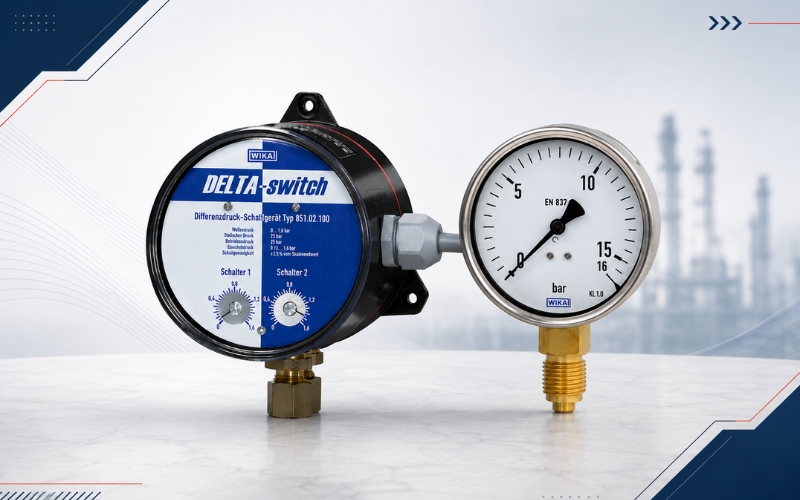
Pressure monitoring and control are critical for ensuring the safety, efficiency, and reliability of industrial processes. From hydraulic systems and air compressors to chemical plants, power stations, pharmaceutical manufacturing, and water treatment facilities, maintaining the correct pressure is essential for smooth operations. Two of the most commonly used instruments in industrial pressure measurement are the Pressure Gauge and the Pressure Switch. Although both are used in pressure-related applications, they serve different purposes and should not be used interchangeably.
A Pressure Gauge measures and displays the pressure within a system, allowing operators to monitor operating conditions in real time. A Pressure Switch, on the other hand, detects pressure changes and automatically activates or deactivates an electrical circuit when a preset pressure level is reached. Selecting the right instrument depends on your application, operating conditions, automation requirements, and safety standards.
Jayantilal Bros. supplies a comprehensive range of Pressure Gauges, Pressure Switches, Baumer Pressure Switches, WIKA Pressure Gauges, Pressure Transmitters, and Industrial Measuring Instruments for various industrial applications. This guide explains the differences, working principles, applications, advantages, and selection criteria for pressure gauges and pressure switches.
What is a Pressure Gauge?
A Pressure Gauge is a mechanical or digital instrument used to measure and display the pressure of gases or liquids within a system. It provides continuous visual monitoring, enabling operators to ensure that equipment operates within safe pressure limits.
Most industrial pressure gauges use a Bourdon tube, diaphragm, or capsule sensing element to convert pressure into mechanical movement, which is then displayed on a calibrated dial or digital screen.
What is a Pressure Switch?
A Pressure Switch is an automatic control device that detects pressure changes and switches an electrical contact ON or OFF when a preset pressure level is reached. Instead of displaying pressure continuously, it triggers actions such as starting or stopping pumps, compressors, alarms, valves, or other control equipment.
Pressure switches are widely used in industrial automation systems where automatic pressure control is required.
Difference Between Pressure Gauge and Pressure Switch
| Feature | Pressure Gauge | Pressure Switch |
|---|---|---|
| Primary Function | Measures and displays pressure | Controls electrical circuits based on pressure |
| Output | Visual pressure reading | Electrical ON/OFF signal |
| Continuous Monitoring | Yes | No |
| Automation | No | Yes |
| Electrical Contacts | Not Required | Required |
| Applications | Monitoring pressure | Automatic pressure control |
| Maintenance | Low | Moderate |
| Accuracy | High | Depends on switch settings |
How Does a Pressure Gauge Work?
A pressure gauge measures the pressure exerted by a liquid or gas using a sensing element.
The working process includes:
- Pressure enters the sensing element.
- The Bourdon tube or diaphragm deforms.
- Mechanical movement transfers to gears.
- Pointer moves across the dial.
- Pressure value is displayed.
Digital pressure gauges replace mechanical movement with electronic pressure sensors and digital displays.
How Does a Pressure Switch Work?
A pressure switch continuously senses system pressure.
The operating sequence is:
- Pressure enters the sensing chamber.
- Internal diaphragm or piston moves.
- Movement reaches the preset switching point.
- Electrical contacts open or close.
- Connected equipment starts or stops automatically.
Pressure switches eliminate manual intervention and improve process automation.
Types of Pressure Gauges
Bourdon Tube Pressure Gauge
Suitable for medium and high-pressure industrial applications.
Applications:
- Air Compressors
- Pumps
- Hydraulic Systems
- Industrial Machinery
Stainless Steel Pressure Gauge
Designed for corrosive environments.
Applications:
- Chemical Plants
- Pharmaceutical Industry
- Marine Applications
- Food Processing
Diaphragm Pressure Gauge
Suitable for viscous, contaminated, or corrosive fluids.
Applications:
- Chemical Industry
- Water Treatment
- Pharmaceutical Plants
Differential Pressure Gauge
Measures pressure difference between two points.
Applications:
- Filter Monitoring
- HVAC Systems
- Flow Measurement
Digital Pressure Gauge
Provides highly accurate electronic pressure readings.
Applications:
- Calibration
- Testing Laboratories
- Process Automation
Types of Pressure Switches
Mechanical Pressure Switch
Uses springs and diaphragms to activate electrical contacts.
Applications:
- Compressors
- Pumps
- Hydraulic Equipment
Electronic Pressure Switch
Uses electronic sensors for precise switching.
Applications:
- Automation Systems
- Process Control
- Industrial Machinery
Baumer Pressure Switch
Baumer Pressure Switches are known for their high reliability, repeatability, and long service life. They are widely used in industrial automation, hydraulic systems, process industries, and OEM equipment where precise pressure control is essential.
Explosion Proof Pressure Switch
Designed for hazardous industrial environments.
Applications:
- Oil & Gas
- Petrochemical Plants
- Chemical Processing
Industrial Applications
Manufacturing Industry
Pressure gauges monitor production equipment, while pressure switches automate machine operations.
Hydraulic Systems
Pressure gauges monitor hydraulic pressure, and pressure switches control hydraulic pumps automatically.
Air Compressors
Pressure gauges display air pressure, while pressure switches automatically stop and start compressors.
Chemical Industry
Pressure gauges ensure process safety, while pressure switches provide automatic pressure protection.
Water Treatment Plants
Pressure gauges monitor filtration systems, and pressure switches control pumps and booster systems.
Pharmaceutical Industry
Both instruments ensure controlled pressure during sterile manufacturing processes.
HVAC Systems
Pressure gauges monitor refrigerant pressure, while pressure switches protect compressors from abnormal pressure conditions.
Oil & Gas Industry
Pressure gauges provide continuous monitoring, while pressure switches activate alarms and shutdown systems during pressure fluctuations.
Advantages of Pressure Gauges
- Continuous pressure monitoring
- High measurement accuracy
- Easy installation
- Low maintenance
- Long service life
- Cost-effective solution
- Wide pressure ranges available
Advantages of Pressure Switches
- Automatic equipment control
- Improved process safety
- Reduced manual operation
- Supports industrial automation
- Protects pumps and compressors
- Prevents overpressure conditions
- Improves energy efficiency
How to Choose Between a Pressure Gauge and Pressure Switch
Consider the following before selecting an instrument:
Choose a Pressure Gauge if:
- Continuous pressure monitoring is required.
- Operators need visual pressure readings.
- Manual inspection is sufficient.
- Process control is not automated.
Choose a Pressure Switch if:
- Automatic equipment control is required.
- Pumps or compressors need automatic ON/OFF operation.
- Pressure alarms are required.
- Industrial automation is implemented.
In many industrial systems, both instruments are installed together to provide accurate monitoring and automatic pressure control.
Why Choose Jayantilal Bros.?
Jayantilal Bros. supplies premium-quality industrial pressure measurement solutions for a wide range of industries. Our product portfolio includes:
- Pressure Gauges
- WIKA Pressure Gauges
- Baumer Pressure Switches
- Pressure Switches
- Bourdon Tube Pressure Gauges
- Stainless Steel Pressure Gauges
- Pressure Transmitters
- Industrial Thermometers
- Temperature Gauges
- Measuring Instruments
With decades of experience, we help customers select the right products based on pressure range, media compatibility, application, and industry standards.
Conclusion
While Pressure Gauges and Pressure Switches are both essential components of industrial pressure systems, they serve distinct purposes. A pressure gauge provides accurate, real-time pressure readings for monitoring, whereas a pressure switch automates system control by activating or deactivating equipment at preset pressure levels. Choosing the right instrument—or using both together—helps improve operational efficiency, enhance safety, and reduce downtime. Jayantilal Bros. offers a complete range of Pressure Gauges, Baumer Pressure Switches, WIKA Pressure Gauges, and Industrial Measuring Instruments, ensuring reliable solutions for diverse industrial applications.
Pressure Gauges & Pressure Switches (FAQ)
A Pressure Gauge measures and displays pressure continuously, whereas a Pressure Switch automatically controls electrical equipment when a preset pressure is reached.
No. A pressure gauge only displays pressure, while a pressure switch performs automatic control functions.
They are widely used in compressors, hydraulic systems, pumps, HVAC systems, water treatment plants, and industrial automation.
Manufacturing, chemical processing, pharmaceuticals, food processing, oil & gas, water treatment, and power generation.
Baumer Pressure Switches are known for high accuracy, durability, reliable switching performance, and suitability for demanding industrial environments.
Yes. Most industrial systems use a pressure gauge for monitoring and a pressure switch for automatic control, ensuring both visibility and operational safety.